Muscle Memory and Milliseconds: The Science Lab Quietly Revolutionizing Pit Crew Performance
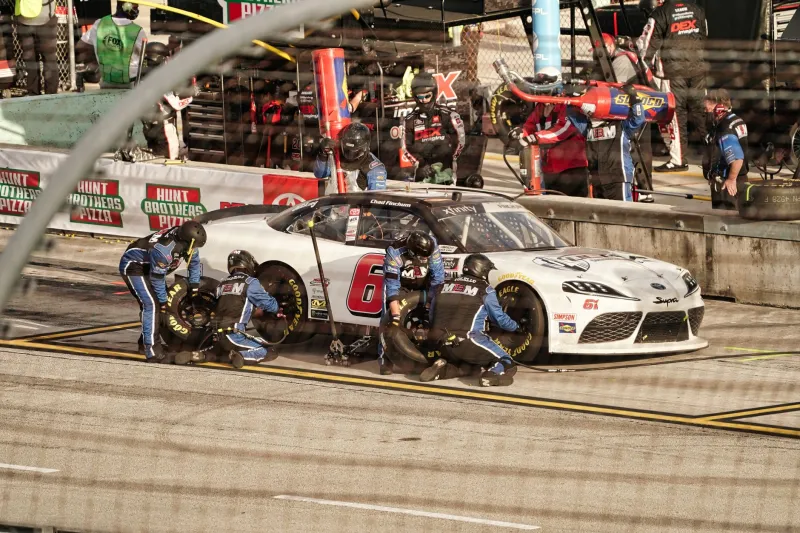
There's a moment during a pit stop — somewhere between the car rolling to a halt and the rear tires locking back into place — where the difference between a championship and a runner-up trophy lives. It lasts maybe 1.3 seconds. And right now, the smartest teams in American motorsports are spending millions of dollars trying to shave another tenth off that window.
The way they're doing it might surprise you.
Forget the old-school image of a bunch of big guys with air wrenches practicing in a parking lot. The modern pit crew operation looks a whole lot more like a sports science facility at an SEC university than anything you'd expect to find in a race shop. Motion capture cameras. Force plates. Electromyography sensors taped to forearms and hamstrings. Biomechanics PhDs with laptops running footage at one-tenth speed. This is where fractions of a second get built — one muscle fiber at a time.
Recruiting From the Wrong Sport (On Purpose)
Here's something that'll make a traditional racing fan do a double-take: some of the best pit crew candidates in the country right now have never touched a lug nut in their lives. Teams are increasingly pulling athletes from football, gymnastics, wrestling, and track and field — sports that develop the exact explosive, short-burst physical profile that a tire changer or jackman needs to operate at peak efficiency.
The logic is pretty straightforward once you break it down. A tire changer's job demands something closer to a sprinter's fast-twitch muscle explosion than anything you'd develop changing tires at a shop on weekends. The movement is violent, precise, and done under psychological pressure that most athletes never experience. You're not just strong — you have to be strong right now, in a pattern that's been drilled so deep into your nervous system that adrenaline can't scramble it.
Former NFL players, collegiate gymnasts, and Division I wrestlers are showing up at pit crew combines and genuinely competing. And when teams run them through biomechanical screening, the numbers often back up what the eye test suggests — these athletes have bodies that were built, either by genetics or years of sport-specific training, for exactly this kind of work.
What the Motion Capture Lab Actually Reveals
When a team sets up a full motion capture session for a pit crew member, they're not just watching to see if the tire gets changed fast. They're mapping every joint angle, every weight shift, every micro-hesitation in the movement chain. The data is granular in a way that's almost uncomfortable — you can see exactly where a jackman is losing 0.08 seconds because his plant foot is hitting the ground two inches outside the optimal position.
That kind of feedback used to be impossible to deliver. A crew chief might watch film and say, "Your footwork looks a little off." Now a biomechanics coach can pull up a 3D skeletal overlay and show a tire carrier the precise moment his center of gravity shifts in a way that costs momentum. It's the difference between coaching by feel and coaching by physics.
Force plates add another layer. When a tire changer drops into his stance, the plate measures exactly how much force he's generating, in which direction, and how quickly. Teams compare those numbers against an internal benchmark — a kind of performance fingerprint built from the fastest stops in their history — and identify gaps in real time. Training protocols get adjusted accordingly, sometimes week to week during the season.
Reprogramming the Body's Autopilot
One of the trickier challenges in this whole process is something sports scientists call "motor pattern interference." Basically, if you've spent years developing movement habits in one sport, those patterns are wired deep. Getting a former tight end to rewire his footwork for a jack drop — where the physics and the spatial demands are completely different from anything he's done before — takes deliberate, repetitive practice at a neurological level.
This is where personalized training protocols come in. Rather than running every crew member through the same regimen, teams are now building individualized programs based on each athlete's movement profile, their sport background, and the specific role they'll play on pit road. A jackman's program looks nothing like a tire carrier's. The muscle demands, the range of motion requirements, the reaction patterns — they're distinct enough that a one-size-fits-all approach leaves performance on the table.
Some teams are even incorporating reactive training tools — think light boards and random-signal response equipment — to simulate the unpredictability of a live pit stop environment. The goal is to make the correct movement pattern so deeply ingrained that it fires automatically, even when the car comes in at a weird angle or the driver radios in an unexpected adjustment call.
The Genetic Conversation Nobody Wants to Have Out Loud
Here's where things get a little more sensitive. A handful of teams — mostly at the top levels of NASCAR and sports car racing — have quietly started incorporating genetic screening into their crew evaluation process. Specifically, they're looking at markers tied to muscle fiber composition: the ratio of fast-twitch to slow-twitch fibers a given athlete is carrying.
Fast-twitch dominance is a significant physical advantage for pit crew work. It's the biological foundation of explosive, powerful movement. You can train to improve your fast-twitch output, but you can't fundamentally change the ratio you were born with. Some athletes are simply built better for this job at a cellular level.
Teams aren't making hiring decisions based on DNA alone — at least, none that will say so publicly. But the data is being factored into development decisions. If you've got two athletes with similar skill levels and one has a measurably better genetic profile for explosive performance, that's information a performance director is going to use.
Speed Is a Science Project Now
What's remarkable about all of this isn't just the technology involved — it's the cultural shift it represents. For a long time, pit crew performance was treated almost like a craft. You hired guys who were tough and coachable, you ran them through reps, and you hoped they peaked when it mattered. Talent and grit were the variables that mattered most.
That mindset hasn't disappeared, but it's been supplemented by something a lot more systematic. The teams investing in biomechanics infrastructure are treating pit crew performance like an engineering problem — one with measurable inputs, identifiable inefficiencies, and solutions you can iterate on.
In a sport where tenths of a second separate winners from also-rans, that approach isn't just interesting. It's a competitive necessity.
The stopwatch doesn't lie, and right now, the teams with the best science are the ones finding time that nobody else even knew was there.