Junkyard Genius: How Budget Builders Are Wrenching Their Way to the Winner's Circle
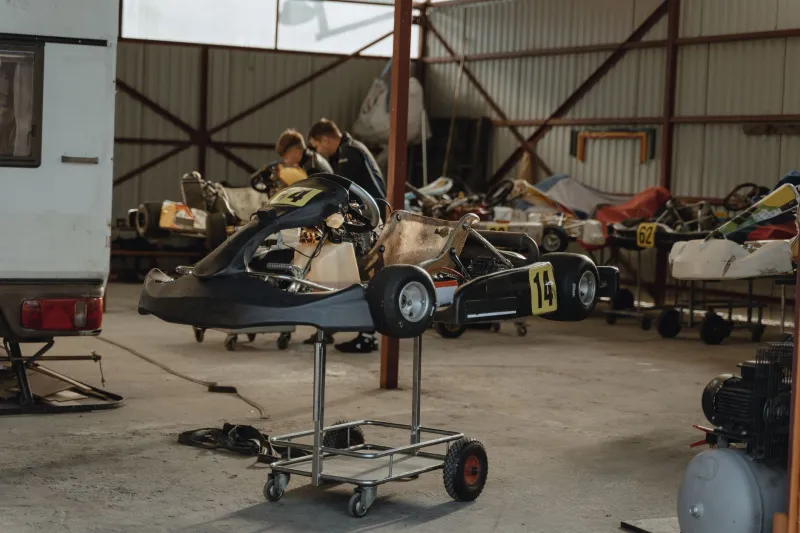
Walk through the pits at any regional short track on a Saturday night and you'll find two kinds of teams. There are the ones with matching crew shirts, color-coordinated toolboxes, and trailers that cost more than most people's houses. Then there are the others — the guys with grease-stained jeans, mismatched socket sets, and cars that look like they were assembled during a fever dream. Don't let the optics fool you. That second group? They're often the ones holding the trophy at the end of the night.
Grassroots racing in America has always had a DIY heartbeat, but a new generation of builder-racers is taking junkyard engineering to a level that's genuinely turning heads. These aren't just people making do — they're innovating in ways that well-funded teams straight-up haven't thought of yet.
The Junkyard as a Parts Catalog
For teams operating on shoestring budgets, the local salvage yard isn't a last resort. It's a first stop. Suspension geometry from a wrecked late-model sedan, wheel hubs off a front-wheel-drive minivan, steering components pulled from a totaled pickup — in the right hands, these castoffs become the building blocks of something genuinely fast.
Take the story of a small-town Indiana team that spent two seasons campaigning a limited late model built almost entirely from donor vehicles. The front suspension? Sourced from a crashed Impala at a self-serve yard outside Indianapolis. The rear end housing came from a Ford Explorer, modified and narrowed in-house. Their best finish before a factory-affiliated team with ten times the budget edged them out at the line? A runner-up at their regional points championship.
The crew chief behind that build, a guy who taught himself fabrication from YouTube videos and old racing manuals, put it simply: "When you can't buy your way out of a problem, you figure it out. You learn the why behind everything, not just the how."
That mindset is what separates a parts-swapper from a genuine junkyard genius.
Constraints as a Catalyst
There's a principle in engineering circles — one that gets talked about in aerospace and software development but rarely in racing — that constraint breeds creativity. When you're not limited by what's available on a shelf, you never have to ask whether there's a better way. Budget builders don't have that luxury, and it turns out that's a massive advantage.
Consider how factory-supported teams approach a problem like weight distribution. They order a custom component from a trusted supplier, bolt it on, and move forward. A junkyard builder facing the same problem might spend three weekends experimenting with different donor-car components, testing combinations that no race parts catalog would ever suggest. Sometimes they land on something genuinely novel. Sometimes they don't. But the process builds a depth of mechanical intuition that money simply cannot purchase.
This isn't just romanticizing poverty — there's real evidence backing it up. Some of the most creative rule-book-legal innovations in regional racing over the last decade have come out of small-budget programs that couldn't afford conventional solutions.
Welding, Wits, and a Little Bit of Wizardry
The fabrication skills on display in these grassroots shops are legitimately impressive. We're talking about guys who can look at two incompatible components and figure out an adapter plate solution in their head before they've even picked up a pencil. Roll cage work that meets or exceeds sanctioning body requirements, done with a used welder bought off Craigslist. Custom brackets machined on a decades-old mill that was rescued from a closing shop.
One particularly creative team in the Southeast built their own rear suspension geometry tool — a homemade version of equipment that typically costs thousands — out of angle iron and threaded rod. It let them dial in their setup with a precision that rivaled what the big-budget guys were doing with laser-guided equipment. Total cost of materials: under forty bucks.
These aren't flukes or one-off stories. This is the culture of American grassroots racing, and it's thriving.
The Community Behind the Creativity
What makes the junkyard engineering scene really tick isn't just individual brilliance — it's community. Online forums, Facebook groups, and Discord servers have become treasure troves of shared knowledge for budget builders. Someone in Ohio figures out that a specific GM truck differential can be adapted to fit a popular entry-level class car with a relatively simple modification. Within weeks, builders from Texas to Maine are running the same setup.
This open-source approach to racing knowledge is completely at odds with how the top levels of motorsport operate, where technical secrets are guarded with near-paranoid intensity. In the grassroots world, the prevailing attitude is that a rising tide lifts all boats. Better competition makes everyone better. Share the trick, improve the field, and let the best driver win.
That collaborative spirit shows up in the pits too. It's not uncommon to see two competing teams sharing tools, lending parts, or helping each other diagnose a problem between sessions. The competition is fierce, but the community is genuine.
When the Junkyard Build Goes Pro
Here's the part that'll really raise some eyebrows: junkyard-built programs have occasionally served as proving grounds that eventually caught the attention of better-funded operations. A handful of mechanics who cut their teeth building creative low-budget racers have gone on to work for professional teams, bringing that resourceful, first-principles thinking with them.
The reasoning makes sense when you think about it. Someone who learned to make a car fast without money learns why a car is fast. When you hand that person an actual budget, the results can be remarkable. The constraints they worked under didn't hold them back — they built a foundation of knowledge that more comfortable paths to the sport simply don't provide.
The Real Horsepower Is Between the Ears
At Harvick Motorsports, we talk a lot about the technology and data and engineering that drives performance at the highest levels of the sport. And that stuff is genuinely fascinating. But there's something deeply compelling about what's happening in the other direction — in the garages where the budget is tight, the hours are long, and the only way forward is to outthink everyone else in the paddock.
The junkyard builders aren't just keeping grassroots racing alive. They're reminding all of us what the sport is actually about at its core. It's not about who can spend the most. It's about who wants it the most — and who's willing to get creative enough to go get it.
Next time you're at a local track and you see a car that looks a little rough around the edges, take a closer look before you write it off. There might be a genius behind that wheel, and an even bigger one back in the shop.