From the Feed to the Fast Lane: How Online Creators Are Blowing Up Racing's Closed-Door Knowledge Club
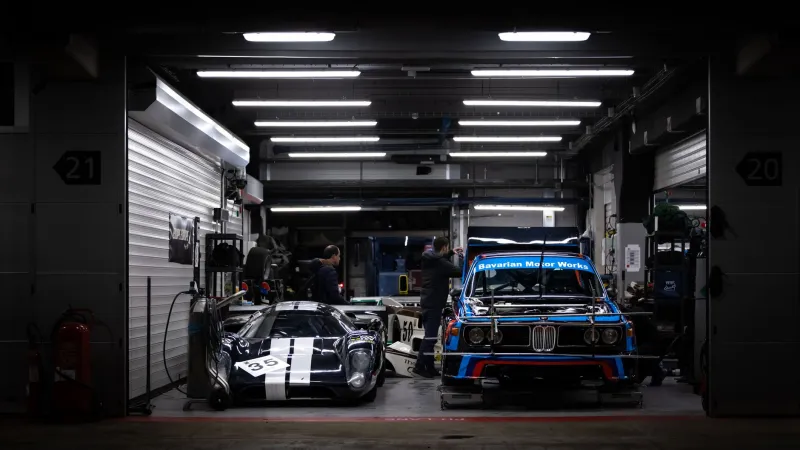
Not long ago, if you wanted to learn how a professional race team set up suspension geometry, you had two options: get hired by one, or pay a small fortune to attend a racing school that might — might — share a fraction of what actually happens in a competitive garage. The knowledge lived behind NDAs, handshakes, and years of earned trust. That was just the way things worked.
Then the internet showed up and kicked the door off its hinges.
Today, a 19-year-old kid in rural Ohio can pull up a 45-minute YouTube breakdown of corner-weight balancing, watch a former NASCAR crew chief walk through shock tuning on TikTok, and join a Discord server where working motorsports engineers debate data acquisition strategies in real time. The gatekeepers didn't see it coming. And honestly? A lot of them still haven't fully processed what hit them.
The Old System and Who It Served
Let's be honest about how traditional racing knowledge has always flowed. It moved vertically — from established teams down to selected apprentices, from accredited schools to students who could afford the tuition. Places like the Skip Barber Racing School or the various manufacturer-backed training programs weren't cheap, and they weren't designed to be. Exclusivity was part of the value proposition.
That model worked for a long time because there was no alternative. If you wanted legitimate technical insight, you had to buy into the pipeline. Teams hoarded setup data like military intelligence. Fabrication techniques were passed down like family recipes — quietly, selectively, and only to people already inside the circle.
The result was a sport that reproduced its own hierarchy pretty effectively. Well-funded teams kept their edges. Well-connected families kept their kids in the pipeline. And the genuinely talented kid from a working-class background who couldn't afford the entry fee? He watched from the fence.
Enter the Content Creators
The shift didn't happen overnight, but it accelerated dramatically around 2018 and exploded post-pandemic. Suddenly, former crew members who'd been laid off or burned out started channels. Engineers who'd spent years at top-tier teams began sharing what they knew — not all of it, but enough to genuinely move the needle for people on the outside.
Channels dedicated to grassroots racing tech started pulling hundreds of thousands of subscribers. Short-form content on TikTok and Instagram Reels made bite-sized engineering concepts go viral in ways nobody in the traditional racing world anticipated. A clip explaining how tire pressure affects handling balance could rack up two million views in a week. That's not a niche audience anymore. That's a movement.
What makes this particularly disruptive isn't just the accessibility — it's the quality. These aren't hobbyists guessing at concepts. Many of the most-followed racing educators online have genuine professional pedigrees. They've worked in pit lanes, built championship-winning cars, and logged years of real-world experience. They're choosing to share that experience publicly, and their audiences are eating it up.
The Tension in the Garage
Predictably, not everyone in the established racing world is thrilled.
There's a real anxiety among some legacy institutions that their value proposition is eroding. If the information that once justified a $15,000 racing school enrollment is now freely available on YouTube, what exactly are you selling? The answer, increasingly, has to be experience and network rather than raw knowledge — and that's a harder pitch to make.
Some teams have quietly updated their NDAs and internal policies in response to the creator economy, spooked by the idea of proprietary setups showing up in a social media breakdown. There's a legitimate tension there. Competitive advantage in racing is often measured in hundredths of a second, and anything that levels the playing field can feel threatening when you've spent millions building that edge.
But here's the counterargument that's gaining traction: the rising tide lifts all boats. When more people understand racing at a technical level, the overall talent pool deepens. Teams that once struggled to find qualified crew members in smaller markets are finding applicants who've self-educated through online content and arrive with a surprisingly solid foundation. That's not a threat — that's a pipeline.
What the Digital Classroom Actually Looks Like
Spend any time in the racing corners of YouTube and you'll find a genuinely diverse ecosystem. There are channels focused purely on data analysis, walking viewers through how to read telemetry and identify where lap time is being lost. Others dig into fabrication — welding techniques, chassis building, roll cage design — with a level of practical detail that would have been unthinkable to find publicly a decade ago.
The community aspect might be the most underrated piece of the whole thing. Reddit threads, Discord servers, and Facebook groups dedicated to specific racing disciplines have become legitimate knowledge-sharing hubs. A question about setup adjustments for a local dirt oval might get answered by someone who's spent twenty years doing exactly that at a professional level. The barriers to that kind of mentorship have essentially collapsed.
For aspiring drivers, the impact is just as significant. Sim racing communities have merged with real-world coaching content in ways that create surprisingly comprehensive development pathways. Young drivers are arriving at their first real track days with a mental framework for racecraft that used to take years of expensive seat time to build.
Where This Goes From Here
The traditional institutions aren't going away — but they're adapting, whether they want to admit it or not. Some racing schools have leaned into the content creator model themselves, launching their own YouTube channels and social presences to stay relevant. A few have restructured their curriculum to emphasize what online content can't replicate: hands-on time in the car, real feedback loops, and the irreplaceable value of being physically present in a competitive environment.
The smarter teams are treating the creator economy as a recruiting tool rather than a threat. If someone has spent two years deep-diving into racing engineering content online and shows up to an interview with genuine knowledge, that's not a problem — that's exactly the kind of self-motivated person you want in your garage.
The knowledge monopoly that once defined how racing expertise was distributed is cracking. It's not fully broken yet, and there are still advantages that only come from being inside the machine. But the gap between inside and outside has never been narrower — and that's genuinely good for the sport.
For a discipline that's always claimed to be about pure performance, it's hard to argue against a world where the best ideas win, regardless of where they came from.