Trust at 60 MPH: The Human Side of What Happens Over the Wall
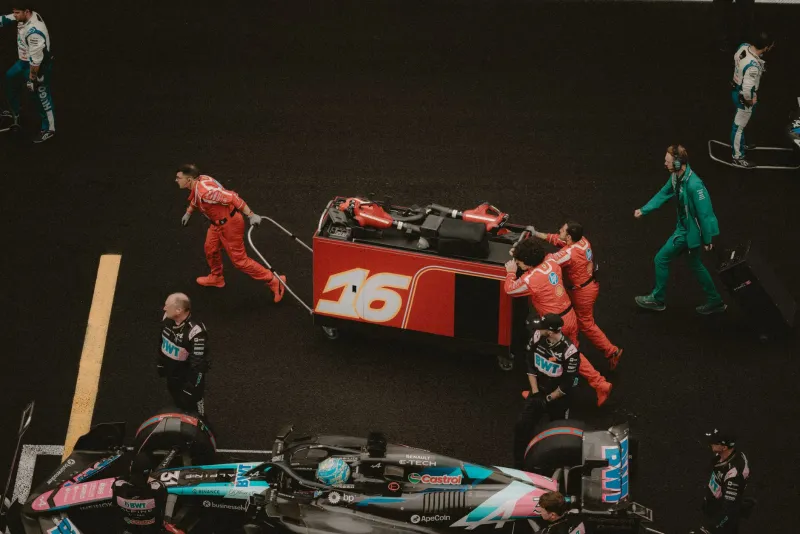
Fifteen seconds. That's roughly how long an elite NASCAR pit stop takes from the moment a car crosses the pit road entry to when it screams back onto the track. In that window, six or seven people — each carrying a specific job, a specific tool, and a very specific pressure — have to execute a sequence that would make a Swiss watchmaker nervous.
And here's the thing nobody talks about enough: the mechanical stuff is almost the easy part.
When the Clock Starts, the Brain Goes Somewhere Else
Talk to enough pit crew members and you start hearing the same phrase over and over — muscle memory. But that's a bit of a shortcut answer. What's actually happening inside a crew member's head during a stop is a fascinating mix of hyper-focused attention and deliberate mental quieting.
"You train so your hands know what to do before your brain catches up," says one veteran tire carrier who's worked with multiple Cup Series teams over the past decade. "But if something goes wrong — a lug nut cross-threads, the jack doesn't catch right — that's when you find out who's really dialed in. Because now you're improvising at full speed."
Sports psychologists who work with elite athletes describe this state as a kind of flow, the same mental zone a basketball player enters when they're shooting unconsciously or a quarterback reads a defense before the snap. The difference in pit road? One mental hiccup doesn't just cost a basket. It can cost a race, a points position, or — in worst-case scenarios — someone's safety.
Chemistry Isn't Built in a Day
Crew chiefs are almost universal on this point: you can have the most physically gifted pit crew in the garage, but if they don't trust each other, they're going to be slow.
Trust gets built in practice. The top teams run thousands of simulated stops before a single green flag drops in January. Not just to sharpen technique, but to stress-test relationships. Who stays calm when the jack handle slips? Who communicates clearly when there's a problem? Who can handle the crew chief barking adjustments mid-stop without losing their rhythm?
"We put guys in uncomfortable situations on purpose," explains a crew chief currently working in the Cup Series. "We'll run stops with noise pumped in, with distractions, with unexpected variables. You want to find out how people react before race day, not during it."
This kind of deliberate stress exposure is borrowed directly from military and first-responder training. The idea is that pressure performance is a skill — and like any skill, it can be coached, drilled, and improved.
The Language Nobody Hears on the Broadcast
Watch a pit stop on TV and you'll see controlled chaos. What you won't hear is the communication layer running underneath it — abbreviated calls, hand signals, and a kind of shorthand language that takes a full season to develop between crew members.
The over-the-wall crew isn't getting constant instructions from the crew chief during a stop. There isn't time for that. Instead, the crew chief's role shifts to pre-stop intel — tire strategy, fuel window, track position decisions — while the crew executes based on what they've rehearsed.
"It's like a jazz band," says one jackman who's been in the sport for over fifteen years. "Everyone knows the song. But in the moment, you're listening to each other, adjusting, responding. Nobody's reading off sheet music."
That analogy holds up better than it might seem. Studies on high-performance teams in fields ranging from surgery to aviation consistently show that the best crews develop implicit coordination — the ability to anticipate each other's moves without explicit communication. In pit road terms, that's the tire changer who feels the jackman coming before he sees him, or the fuel man who reads the car's position off the wall and adjusts his approach automatically.
The Metrics Behind the Magic
Modern racing teams don't leave pit stop performance to gut feel. High-speed cameras, timing software, and motion-capture technology now break down every stop into individual segments — jack time, lug nut engagement, tire mount, fuel flow rate. The data gets reviewed after every practice session, every race, and every off-season training block.
This is where the Tech & Innovation side of the sport gets genuinely interesting. Some teams have begun using biomechanics analysis to study body mechanics on the over-the-wall crew the same way NFL teams analyze linemen's footwork. Small adjustments in how a tire carrier plants his feet or how a changer approaches the lug pattern can shave fractions of a second that add up to tenths over a race.
But the data also reveals something the stopwatch can't fully capture: consistency. A crew that averages 13.8 seconds but swings between 12.5 and 15.2 is less valuable than one that holds 13.4 every single time. Variance is the enemy. And variance, most crew chiefs will tell you, is almost always a people problem before it's a technique problem.
What Separates the Best From the Rest
At the highest level, the physical gap between pit crews is genuinely small. The top ten crews in any given series are separated by fractions of a second on any given stop. So what actually creates the separation between the teams that win pit road and the ones that give up track position every Sunday?
The crew members who've been around long enough to have perspective tend to land on the same answer: accountability without blame.
"Nobody's perfect. Mistakes happen," says one tire changer who's been part of championship-winning crews. "The difference is what happens after. Do you get in your head? Do you start pointing fingers? Or does the crew pull together and make the next stop cleaner? That's culture. And culture is built by the crew chief, day one."
That mindset — acknowledging errors, correcting fast, and moving forward without dwelling — is a psychological discipline as much as a physical one. It's also, not coincidentally, one of the things that makes great pit crews genuinely fascinating to watch, even if most of the action is invisible to the casual fan.
The car gets the glory. The driver gets the trophy. But fifteen seconds over the wall, repeated thirty or forty times across a season? That's where championships are quietly assembled, one lug nut at a time.