From the Cockpit to Your Car: The Racing Tech That's Keeping Everyday Drivers Alive
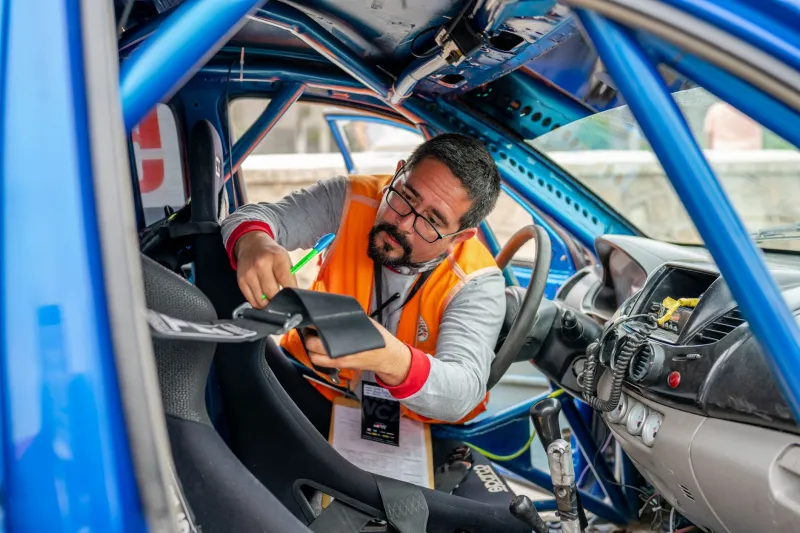
Every time a NASCAR driver climbs out of a crumpled car and waves to the crowd, there's a moment where the crowd exhales. What looks like a miracle is actually the result of decades of relentless safety engineering — work that doesn't stop at the pit lane gate. A surprising amount of what protects you on the interstate every morning started its life strapped around a racing driver going three times the legal speed limit.
This is the story of that pipeline. And it's a lot more personal than most people realize.
The Harness That Started a Revolution
Before the multi-point harness became standard equipment in race cars, drivers relied on basic lap belts — the same kind you'd find in a 1960s family sedan. Then racing started pushing speeds that made those belts genuinely dangerous. A lap belt alone, in a high-speed frontal impact, could cause what engineers grimly call "submarining" — the body sliding forward and under the belt with catastrophic results.
Racing engineers responded with the five- and six-point harness systems still used in sanctioned competition today. These designs distribute crash forces across the chest, shoulders, and pelvis simultaneously, keeping the occupant firmly planted in the seat and dramatically reducing internal injuries.
Sound familiar? It should. Modern three-point seatbelts in consumer vehicles are a direct descendant of that same thinking — spreading load, managing energy, protecting the torso. The geometry has been refined over decades using data collected from actual race crashes, fed back into automotive safety labs, and eventually mandated by federal safety standards. The NHTSA didn't invent that logic from scratch. Racing handed them the blueprint.
HANS and the Neck That Changed Everything
If you want a single piece of technology that illustrates the racetrack-to-road pipeline perfectly, look at the HANS device — the Head and Neck Support system that became mandatory in NASCAR and most major American motorsports series in the early 2000s.
The HANS device was developed by Dr. Robert Hubbard, a biomechanical engineer at Michigan State, after studying the types of head and neck injuries that were killing drivers in crashes that the rest of the car was actually surviving. His solution was deceptively simple: a carbon fiber collar that tethers the helmet to the shoulders, preventing the violent "basilar skull fracture" that had claimed the lives of drivers including Dale Earnhardt Sr. at Daytona in 2001.
Within a few years of widespread adoption in racing, the automotive industry began applying the same biomechanical principles to how consumer headrests are designed and positioned. Active headrest systems — the kind that automatically pivot forward in a rear-end collision to support your neck — owe a conceptual debt to HANS research. It's not a copy; it's an evolution of the same understanding of how the human head behaves in a sudden deceleration event.
"Racing gives you a brutal testing environment," says one safety engineer who has worked with both a major NASCAR team and a Detroit automaker. "You learn things in competition that you'd never be allowed to simulate in a lab. That knowledge has to go somewhere."
Cockpit Protection and the Crumple Zone Connection
The roll cage is another concept most people associate purely with motorsports. And while your daily driver doesn't have a full chromoly steel cage welded into the body, the structural philosophy behind it — creating a protected survival cell around the occupant while allowing the rest of the vehicle to absorb and dissipate energy — is exactly how modern car bodies are engineered.
The "crumple zone" concept, now a cornerstone of automotive safety design, mirrors what racing engineers have long called the "crush structure" around a race car. The idea is the same: sacrifice the machine, save the person inside. Front and rear sections of a consumer vehicle are designed to collapse in a controlled way, converting kinetic energy into deformation rather than letting it transfer directly into the passenger compartment.
Formula-style carbon fiber monocoque construction — where the driver's cell is essentially a rigid tub — has also influenced how automakers think about high-strength steel and aluminum construction in the B-pillars and door beams of production cars. You're riding in a version of a survival cell every single day.
Fire Suppression and the Materials Behind Your Dashboard
Post-crash fire is one of the most terrifying risks in motorsports, and the racing industry has spent enormous resources developing fire-resistant materials and suppression systems. Nomex — the flame-resistant fabric used in driver suits, gloves, and balaclavas — was initially developed by DuPont for industrial use, but it was racing that stress-tested it in real-world fire scenarios and drove its widespread adoption.
That same material philosophy has crept into consumer vehicles. Fire-resistant wiring insulation, improved fuel tank placement, and automatic fuel cutoff systems triggered by crash sensors are all areas where motorsports safety research has influenced production vehicle design. Modern cars are significantly less likely to catch fire after a collision than vehicles from 30 years ago — and part of that progress traces back to what engineers learned watching race cars burn and survive.
The Data Loop That Never Stops
What makes this pipeline so effective isn't just that racing produces innovations — it's that racing produces data. Every crash at a major American motorsport event is documented, analyzed, and often shared with automotive safety researchers. NASCAR's Research and Development Center in Concord, North Carolina has been collaborating with institutions and automakers for years, feeding real-world impact data back into the broader safety ecosystem.
When a driver hits the wall at Bristol at 170 mph and walks away, that's not luck — it's a data point. The accelerometers, the high-speed cameras, the post-crash structural analysis: all of it feeds into a knowledge base that eventually shapes the cars coming off assembly lines in Michigan, Kentucky, and Tennessee.
It's Personal
For former drivers who've been through serious crashes, the connection between racing safety and road safety isn't abstract — it's visceral. Many describe the moment after a major wreck when they realize the equipment did exactly what it was supposed to do. That experience tends to make them vocal advocates for safety technology in everyday vehicles.
"I walked away from a hit that should have ended my career, maybe worse," one former short-track competitor from the Midwest shared. "And then a couple years later, my wife was in a highway accident. The way her car handled that crash — the way she walked away — I recognized it. Same principles. Different package."
That's the real legacy of racing safety innovation. It's not just about protecting the athletes willing to push machines to their limits on a Sunday afternoon. It's about the quiet, unglamorous work of taking what's learned at speed and building it into the vehicles that carry your family home every night.
The checkered flag waves. The engineering keeps going.